
Contract Electronics Manufacturing vs. Going Offshore: What Engineers Actually Discover
19 Jun, 2026If you’ve priced out a PCB assembly run recently, you’ve probably seen offshore quotes that undercut domestic manufacturers by 20 to 50 percent. At that spread, sending your boards overseas seems like the obvious call.
Then the boards come back.
Engineers who’ve been through the offshore cycle tend to tell a similar story. The quoted price was real. So were the costs that came after it: rework, delays, communication overhead, and problems that would’ve been caught in DFM review if anyone had been doing one. Contract electronics manufacturing domestically costs more per board on paper, but the gap narrows fast when you account for everything that happens between the quote and a working product on your bench.
Here’s what the comparison actually looks like once you’re in it.
The Offshore Quote Looks Great on Paper
Offshore contract manufacturers, particularly in China and Southeast Asia, operate at a scale and labor cost that domestic shops can’t match on a per-unit basis. For high-volume production runs of mature, stable designs, that cost advantage is real and significant.
The problem is that most engineers evaluating offshore for the first time aren’t running 50,000-unit production orders. They’re building prototypes, running short production batches, or iterating on a design that isn’t fully locked down. At those volumes and at that stage of development, the per-unit savings get eaten by everything else.
The quoted price covers assembly. It does not cover the full cost of getting working boards into your hands.
Where the Real Costs Show Up
The gap between an offshore quote and what you actually spend typically runs 20 to 30 percent above the original number. That’s not speculation. It’s the consistent range engineers report after accounting for everything the quote didn’t include.
Shipping and tariffs add 15 to 17 percent on their own. Ocean freight takes four to eight weeks. Air freight is faster but expensive. Either way, you’re paying for customs clearance, duties, and the logistics of getting boards from a port to your facility.
Safety stock and inventory buffers become necessary because your supply chain now has a multi-week transit window. If a batch has issues, you can’t get replacements in days. You need backup inventory to avoid halting your production line or missing a delivery commitment.
Expediting fees hit when timelines slip. And they slip more often than the quoted lead time suggests. Port congestion, customs delays, and production scheduling at high-volume facilities all introduce variability that doesn’t exist when your manufacturer is a few states away.
Rework and scrap from quality issues that could have been caught before production. When there’s no DFM review, no engineer reviewing your Gerbers before they hit the line, problems get built into the boards and discovered after delivery. At that point, you’re paying to fix them or paying to rebuild.
Travel for audits and troubleshooting is the cost nobody plans for. When something goes wrong, someone has to fly 18 hours to figure out what happened. That’s not a line item on the quote, but it’s a real expense when boards come back with defects you can’t diagnose remotely.
The Communication Problem Nobody Budgets For
Time zone differences are the obvious friction point. Your engineering team is asleep when your manufacturer’s production floor is running. Questions that would take a five-minute phone call domestically turn into a 24-hour email cycle. Over the course of a build, those delays compound.
But the harder problem is nuance. Specs that seem unambiguous in English sometimes get interpreted differently across languages and engineering cultures. Tolerances, finish requirements, and component substitution rules are areas where small misunderstandings create real problems. In some manufacturing cultures, flagging a potential issue with a customer’s design is seen as confrontational rather than helpful. So problems that an experienced domestic CM would call out during DFM review pass silently through the process and show up in the finished boards.
With a domestic contract electronics manufacturer, you’re typically talking directly to the engineer running your job. Questions get answered in real time. If something in your design looks like it will cause problems in production, you hear about it before the first board is populated, not after.
IP Risk Is Real, Not Theoretical
Sending your design files overseas means your schematics, Gerber files, BOMs, and firmware are in a jurisdiction where intellectual property enforcement is inconsistent at best. Multi-tiered offshore supply chains make it worse: your files may pass through brokers, subcontractors, and component suppliers, each one a potential exposure point.
This isn’t a hypothetical risk. Engineers in competitive product markets have seen offshore manufacturers produce near-identical products for competitors after learning the design and manufacturing process through a contract engagement.
Domestic manufacturing keeps your files in a closed loop. Your designs stay within a single facility under U.S. intellectual property law. For products where the design itself is the competitive advantage, that’s not a nice-to-have. It’s a requirement.
When Offshore Actually Makes Sense
Offshore manufacturing isn’t always the wrong choice. For the right project profile, it’s a legitimate option.
High-volume production of mature designs is where offshore excels. If your design is locked, your BOM is stable, your quality requirements are documented, and you’re ordering tens of thousands of units, the per-unit cost advantage can outweigh the overhead. At that scale, you can afford dedicated quality engineers on-site, you can absorb the shipping timeline, and the savings are substantial enough to justify the management overhead.
Non-critical consumer electronics with flexible timelines and lower compliance requirements are also reasonable offshore candidates. If the product doesn’t require regulatory traceability, and delays of a few weeks aren’t dealbreakers, the cost math can work.
The key is being honest about your actual situation. If you’re still iterating on the design, if your volumes are in the hundreds or low thousands, if you need boards fast, or if your product has compliance requirements, the offshore cost advantage usually disappears once you factor in the full picture.
When Domestic Is the Clear Choice
Certain project types favor domestic contract electronics manufacturing so heavily that the per-unit cost comparison is almost irrelevant.
Medical devices require documented traceability, IPC-compliant processes, and the ability to support FDA regulatory submissions. Offshore manufacturers can claim compliance, but verifying it from 7,000 miles away is difficult and expensive. A domestic manufacturer with medical device PCB assembly experience gives you direct access to quality records and process documentation.
Prototypes and short runs need fast turnaround and the ability to iterate. Shipping prototype boards across the Pacific defeats the purpose of rapid prototyping. A domestic CM with in-house engineering can review your design, flag DFM issues, assemble boards, and get them on your test bench in days rather than months.
Military and defense applications often require ITAR compliance and domestic manufacturing by regulation. That’s a hard requirement, not a preference.
IP-sensitive products in competitive markets need the protection of U.S. legal frameworks and closed-loop manufacturing. If your design is your moat, sending files offshore is a strategic risk.
Tight timelines tied to funding milestones, regulatory windows, or product launches can’t absorb the variability of offshore logistics. When the schedule matters more than the per-unit cost, domestic is the safer bet.
What to Look for in a Domestic Contract Manufacturer
If you’re evaluating domestic CMs, the checklist goes beyond “are they in the U.S.” Not all domestic manufacturers operate the same way.
DFM review as a standard step, not an add-on. The manufacturer should review your design for manufacturability before boards hit the line. This is where problems get caught early. If a CM just assembles what you send without reviewing it, you’re paying for a board stuffer, not a manufacturing partner.
In-house engineering capability. The best CMs can help with more than assembly. Schematic review, PCB layout feedback, thermal analysis, and test fixture development all reduce risk. A manufacturer that builds their own products understands the full development cycle, not just the assembly step.
Prototype-to-production continuity. Working with one manufacturer from prototype through production means your design doesn’t get re-interpreted at every handoff. The team that built your prototypes knows the board’s quirks and history when it’s time to scale.
Documented quality processes. IPC-A-600 Class 2 adherence, AOI on every board, RoHS/REACH compliance capability. These should be standards, not options. Ask for specifics, not just “we take quality seriously.”
Transparent pricing. A good domestic CM gives you a landed cost that includes everything. No surprise line items for setup, tooling, or test after the fact.
Direct engineer access. You should be talking to the person running your job, not a sales rep who relays messages. Real-time communication between your engineering team and the production floor is one of the biggest advantages of domestic manufacturing. Don’t pick a CM that negates it with layers of account management.
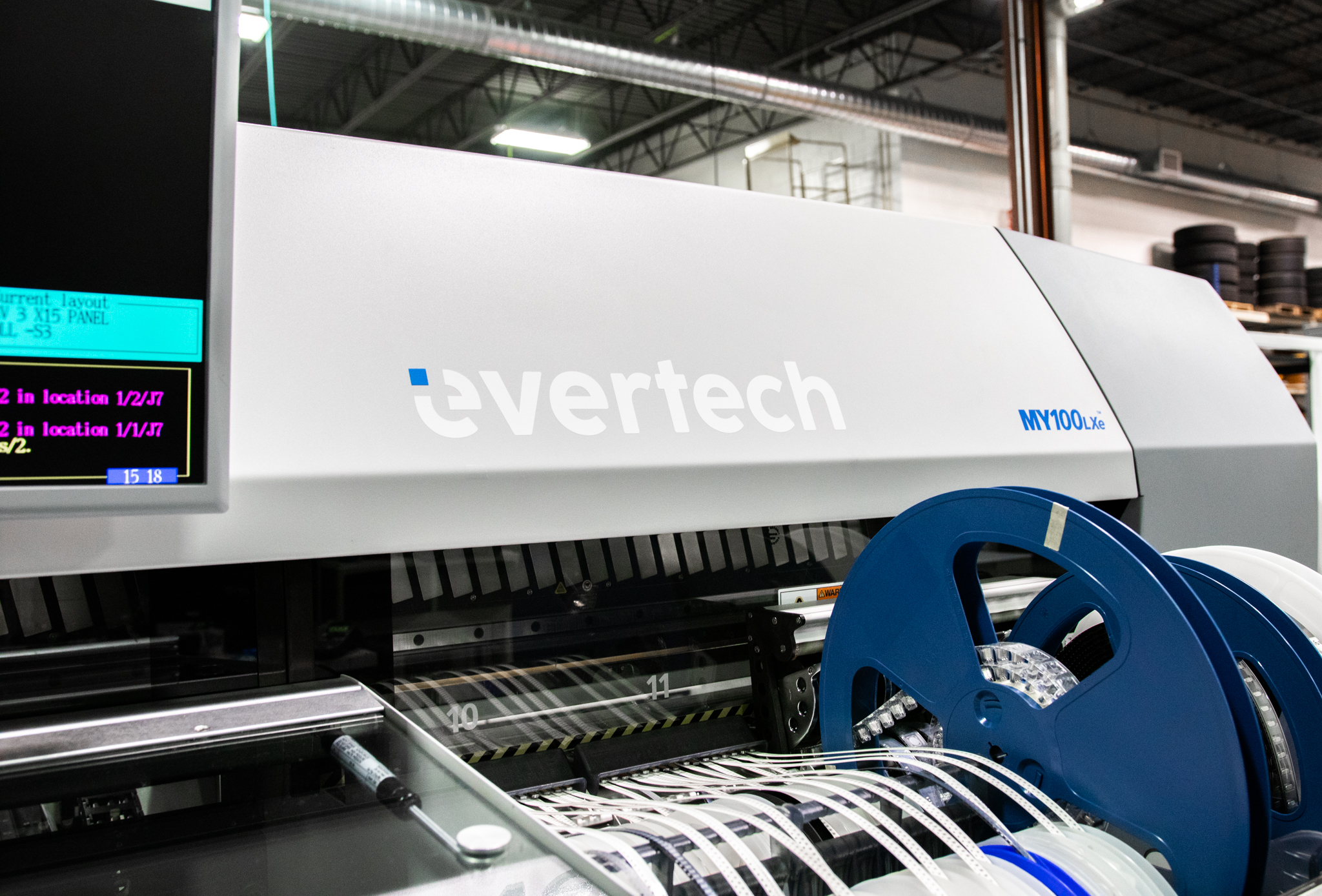
Evertech builds boards in Cedarburg, Wisconsin, and has matched overseas pricing on comparable jobs. If you’re weighing domestic vs. offshore for an upcoming build, reach out and we’ll walk through the numbers with you.